During Storm Goretti, one of Tremenheere’s mature oak trees was brought down, severely damaging Stachys, Rebecca Newnham’s sculptural work long embedded within the gardens. What initially felt like a devastating loss became an opportunity for renewal: the sculpture was carefully restored by the artist, embracing the marks of the storm as part of its evolving story. Now reconfigured and re-situated in a new location within the gardens, Stachys enters its next chapter. We spoke to Rebecca about the damage, the restoration process, and how ideas of cycles, resilience and regeneration continue to shape the work.
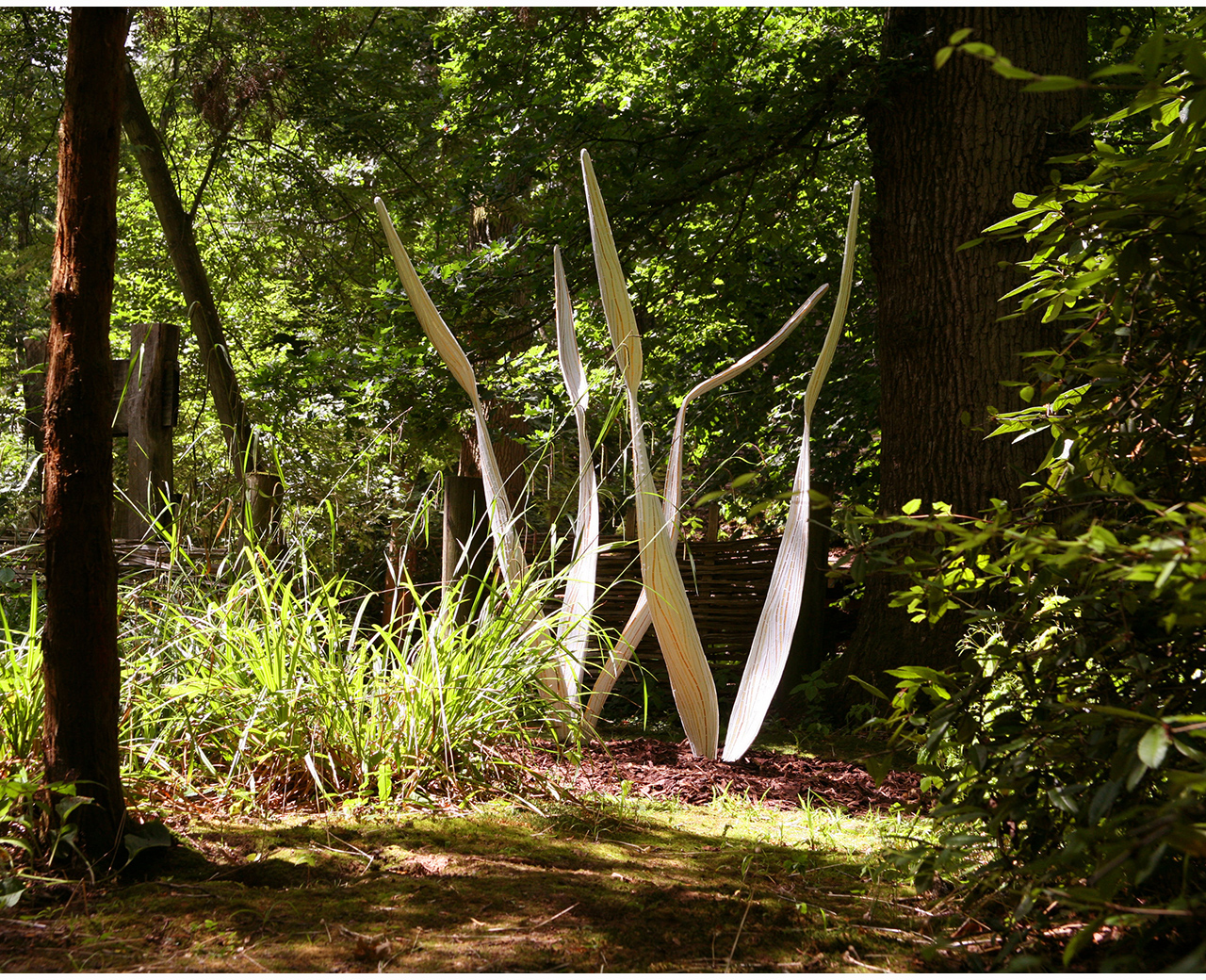
Medium: Steel structure and base, fiberglass form, gold mica glass, enamelled glass, olive imploded glass and white gesso. It is group of 5 uprights joined at the base, the base is in 2 sections.
Dimensions: 2.33 h x 2.33 w x 2.33m d
Edition: unique
2008 & 2026
Stachys has been part of Tremenheere for some time. Can you tell us a little about what inspired this piece and what it means to you, especially in the context of cycles and evolution in your work?
Stachys explores the phenomenon of mass bamboo flowering, in which an entire species blooms and dies simultaneously, producing vast quantities of seed before regenerating anew. This remarkable life cycle is unique to certain bamboos, and embodies a rhythm of death and renewal that Stachys celebrates. The sculpture’s arms open toward the sky, in salute.
I created a body of work following a residency at the Sir Harold Hillier Arboretum in 2008. Stachys grew out of an immersion in the gardens’ living collections and research within their extensive herbarium. Work from this period investigates number sequences and natural proportions, such as the golden section and the Fibonacci series, mathematical patterns that reveal the inherent order underlying organic forms. In botany, numbers help identify and classify species: some flowers are trimerous, with petals in multiples of three, while others have petals in multiples of five. These distinctions often correspond to broader plant divisions such as monocots and dicots, which can be identified by how a seed germinates, the structure of its pollen, and other defining features.
Among the many bamboo species, I was particularly drawn to the clumping genus Phyllostachys. Its floret-bearing spikelets are encased in deciduous, sheath-like bracts. The name derives from the Greek phyllos (“leaf”) and stachys (“spike”).
Some bamboos, known as monocarpic species, flower only once every 130 years. When this rare mass flowering occurs, the spikes produce inflorescences that eventually seed, an event that marks the plant’s imminent death and subsequent rebirth from the seeds it leaves behind. In Stachys, the focus is on the spikes and their protective bracts as characteristic of this extraordinary cycle of life.
When Storm Goretti caused damage to Stachys, what were your initial thoughts? How did you approach the idea of restoring it?
Neil emailed to say that Stachys was destroyed. I was devastated at the loss but also for the loss of so many mature trees in the gardens. Trees represent strength and the resilience of the natural world, and the storm that uprooted and snapped them was a frightening force.
I had to decide if Stachys was salvageable, and when I examined the photo that Neil sent me, I could see that the structural metalwork, although bent under the weight of the fallen trees, was in fact intact. The body of the sculpture, although broken was in large sections. I thought that it might be possible to resurrect the sculpture, and I arranged to visit the gardens a day or so later for a closer look.
When I arrived in the gardens the ground was carpeted in broken branches encrusted with lichen. The lichen’s sea green left a lasting impression, it should have been in the canopy above my head, but it was all smashed and on the ground. I had cast some small fallen branches encrusted in lichen from Tremenheere a few years earlier, as part of a body of work that featured the pond at Tremenheere. These casts were in bronze, aluminium and iron and were titled, Hope, after a quote by Rebecca Solnit in, Hope in the Dark, where she explains, “the branches are hope, the roots are memory”. I had first visited Tremenheere with other members of the Royal Society of Sculptors, and we created an exhibition in the gallery together called, Wander_Land, named after another of Solnit’s books.
Could you walk us through the restoration; from removing the original glass to introducing the new olive-toned elements? What guided your choices along the way?
The broken sculpture was removed to the gallery, the hefty tree limbs than obstructed were chain sawed by the team and volunteers who helped clear paths through the devastation.
It felt appropriate to make the repairs visible, to embrace this chapter in the story of the work. I painted glass with lichen and olive coloured glass enamels and fired them in the kiln. This makes the colour a permanent part of the glass, which will not fade or change. This lichen like glass replaced broken and missing glass on the sculpture. I combined fine glass dust from crushed, imploded olive oil bottles with grout, and where we replaced the grout between the tiles, the areas sparkle with the addition. The olive colour recognises the Garden of Peace, a grove of olive trees, that are to be planted at Tremenheere later this year.
The steel structure, although intact, was flattened and bent. We were able to use leverage to manoeuvre the steel back into place, and as I hoped they seemed to have a memory of the original positions. Broken sections were clamped and adhered back together, joints were sealed; the sculpture was recognisably Stachys, if a little different. It bears witness to the Storm, and is a new version of itself.
Stachys is influenced by Fibonacci sequences, and the storm itself followed a spiral pattern. How do you see the connection between these natural patterns, the garden, and your work?
The Fibonacci sequence of numbers if often found in nature. The Golden Section Ratio governs the sequence. The sequence is 1,1,2,3,5,8,13,21,34,55,89,144,233….
I have long been intrigued with the proportion and in Stachys, the top section of each upright is in golden section proportion to the bottom sections. The bottom sections are 144 cm in length and the top sections are 89 cm in length. Combined, the height is 233cm, all are Fibonacci numbers.
Many of my other sculptures reference this visual proportion, that is so often found in nature, because the work encapsulates characteristics of specific plants and natural phenomena.
We saw social media posts of satellite images of the spiralling storm, which was in perfect Golden Section proportion. Personally, I consider the golden section a blueprint of the language of forms often found in nature, and find it endlessly fascinating and humbling.
The garden and Stachys seem to reflect cycles of growth, loss, and renewal. How do those ideas influence your creative practice, and how did they shape your response to the storm?
The fundamental principle that Stachys embraces is the metaphoric life cycle, in this case of bamboo. The symbolism of a seed germinating, growing towards the light, flourishing and reproducing, echoes throughout nature and human culture.
The arms of the sculpture open skywards in a salute to the universe. I am so glad that we were able to resurrect the pieces into a new version of the work. It felt appropriate not to disguise the breaks but to acknowledge and rework the sculpture in recognition.
The storm was a powerful force, enough to tear the root balls of mature trees from the ground. In its wake, areas of the gardens have been opened up, new views are offered, opportunities for new trees to flourish.
Looking at Stachys now, after the restoration, what are your hopes for the piece and how it will be experienced by visitors?
I hope that the sculpture, on first impression, appears recognisably similar. The sculpture’s open arms that reach upwards are an expression of vitality and joy, and I hope visitors find it optimistic.
On closer examination, the new glass will become apparent, and the symbolism of the renewal will become clear to appreciate.
My work adds to the conversation around the natural environment, and Stachys is part of that narrative.
Thanks to the team at Tremenheere for all their support.
The reconfigured Stachys can now be found in a newly chosen position within the gardens, where it continues its quiet conversation with the landscape. Tremenheere reopens on 14 February, with a locals’ offer available – come and experience the gardens’ changing story, and encounter Stachys for yourself.
