Tir ha Trig brings together the work of Judy Buxton and Virginia Bounds at Tremenheere. Although their painting practices are distinct, the exhibition reflects a long-standing connection through landscape, painting, and shared experience.
Both artists work from direct observation and from time spent within the landscape. Across the exhibition, abstraction and landscape exist together, with paintings shaped by light, atmosphere, memory, and the physicality of paint itself.
In this conversation, Judy Buxton reflects on painting, landscape, solitude, and the experience of making work over many years.
Tir ha Trig brings together the work of you and Virginia Bounds in one exhibition. Judy, how would you describe the relationship between your pieces here?
Although Gini and I work very differently, there are strong connections between us in the exhibition. We both come to landscape through painting from an abstract perspective, trying to make paintings that work on two levels at once.
The paintings hold a sense of landscape and nature, but they also work abstractly across the surface. We both use colour, gesture, and movement in different ways, but there’s a shared feeling around light, space, atmosphere, and being within the landscape.
I think the works sit together quite naturally. They each hold their own energy and personality, but shared concerns are running through them.
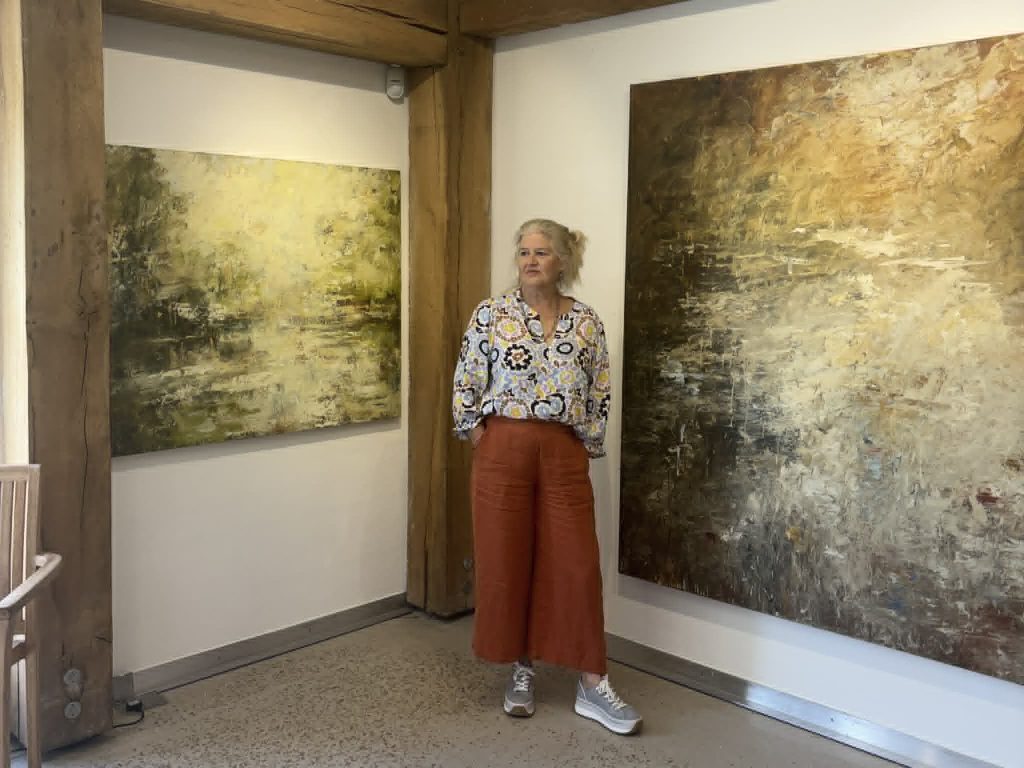
Your work often abstractly responds to landscape. How does this exhibition continue that?
My work is rooted in landscape, but not in a representational sense. It comes from being in a place, walking, observing, and absorbing it, and then allowing those experiences to come into the painting.
Different landscapes carry different energies. Cornwall, for example, has a particular sense of light and weather, while other places bring different feelings and atmospheres. These things inevitably filter into the work, even when they are not consciously referenced.
What remains constant is trying to hold a sense of place without describing it too literally, and allowing the painting to exist on its own terms while still carrying something of the landscape within it.
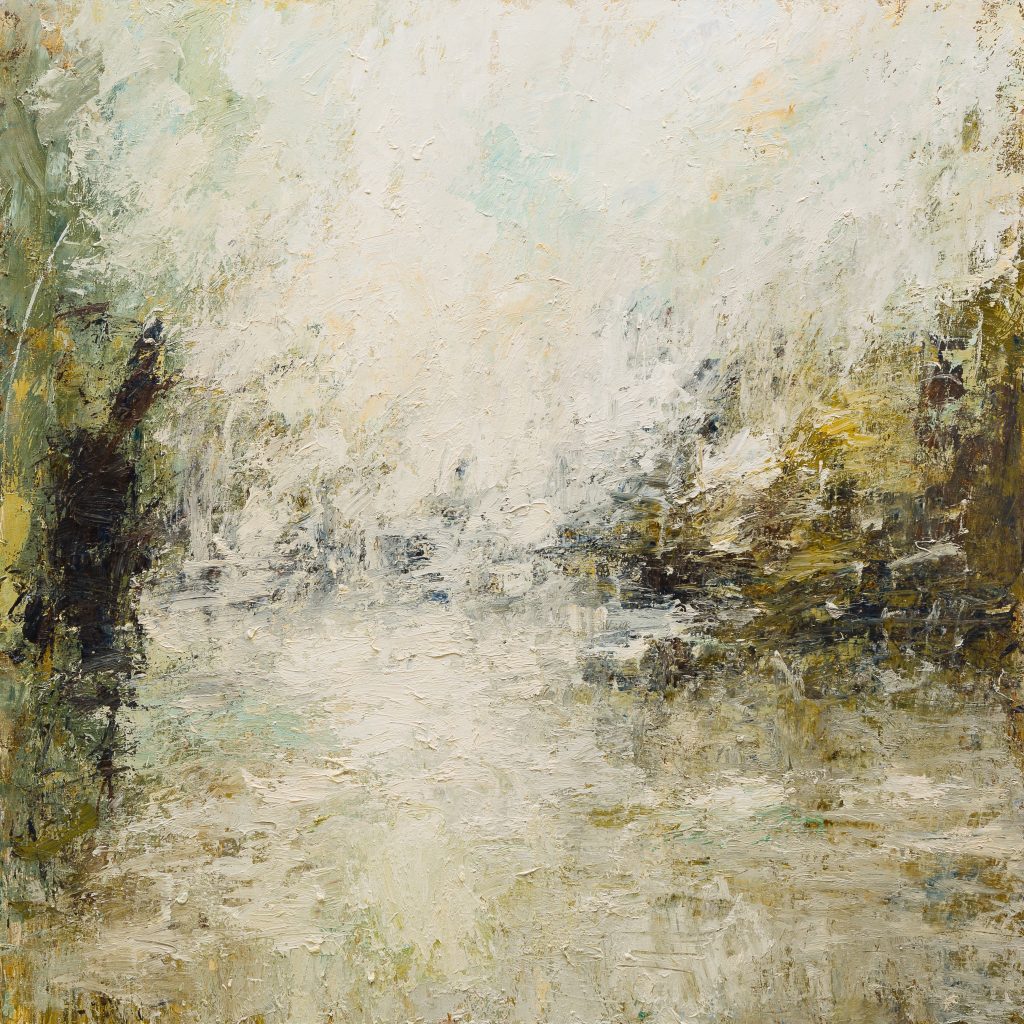
oil on canvas
h. 153 x w. 153 cm
£12,000
The exhibition touches on landscape, memory, and material. How do these ideas appear in your own practice?
Landscape is always present in the work, but it isn’t something I try to describe directly. It’s more about the feeling of being in a place through light, atmosphere, colour, and movement, and how that can be held in paint.
Memory comes into the work in subtle ways. It might come through colour, gesture, or simply a feeling carried from being somewhere rather than a literal image of it. Over time, those impressions stay with you and resurface within the paintings.
Material is equally important. The physicality of paint, its fluidity, density, and the way it moves across the surface, becomes part of the experience of making the work itself.
You often work outdoors in the landscape. What role does solitude play in your process?
Working directly in the landscape requires a certain kind of solitude. There’s something about being alone in a place that allows you to notice things more clearly and really spend time observing.
It’s not about isolation, but about attention. When you’re not distracted, you become more aware of changing light, movement, weather, and sound as well; bird song, seagulls, waves crashing, all of that becomes part of the experience of being there, and small details within the landscape.
Painting outside also removes you from everything else. There are no interruptions or devices, and you begin to feel more inside the landscape rather than observing it from a distance.
How have practical considerations, such as materials, scale, and studio space, shaped your painting over time?
Practical realities have always shaped the work quite directly. The cost of materials, the availability of paint, and the size of a studio all affect what you can make and how you make it.
At different points, I’ve had larger spaces where I could work on a bigger scale and physically step back from the paintings, which changes how you see them and construct them. That distance is important.
Over time, you adapt to what’s available. As materials become more expensive, you adjust your methods and find different ways of working. Those changes inevitably become part of the paintings themselves.
What role does memory or imagined landscape play in the works here?
Memory is always there in the work, but not in a fixed or literal way. It might come through colour, gesture, atmosphere, or simply the feeling of being in a place.
Often, the paintings begin from direct observation or small paintings made outside, but as the work develops, it moves away from that starting point. The painting takes over and becomes something else.
I’m interested in holding onto something of the experience of being in the landscape without describing it too directly.
About Virginia Bounds
Alongside Judy Buxton’s work, Tir ha Trig brings together paintings by Virginia Bounds, an Australian-born painter based in Cornwall whose practice explores the relationship between landscape, atmosphere, memory, and abstraction.
Gini was previously an artist in residence at Tremenheere, where time spent working within the gardens further informed her connection to place and observation. Working from direct experience of the landscape, her paintings move between gesture, colour, and surface, holding a strong sense of atmosphere while allowing the work to exist abstractly in its own right.
Together, the exhibition reflects a shared engagement with painting, place, and the experience of living between Cornwall and Australia.
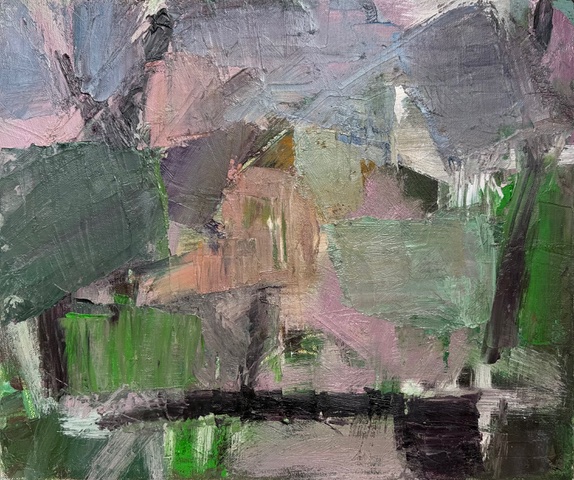
oil on linen
h. 30.5 x w. 36.6 cm
£1,365
Taken together, the works in Tir ha Trig offer a sustained reflection on landscape as both physical experience and internal space, something encountered, absorbed, and carried through painting over time.
Rather than presenting a fixed narrative, the exhibition holds multiple ways of seeing and making, where each work retains its own autonomy while resonating within a shared field of concern.
Judy Buxton extends her thanks to Tremenheere for the invitation to exhibit and to Virginia Bounds for the opportunity to show their work together in this context.
The exhibition continues until 6 June – open Tuesday – Saturday, 11 – 4. Free entry.
